2026年5月11日,常州具身智能数据实



加拿大华裔作家贝拉
加拿大华裔人道主义作家、诗人及思想者贝拉(Bei La)近日正式发布其前沿思想体系——“音乐文学宇宙论”(Music–Literature Cosmology)。这一理论融合文学、音乐、哲学、女性精神、宇宙意识与文明修复理论,被部分国际学界与跨领域研究者视为一种“后后现代文明精神框架”的重要探索。
目前,已有欧美人文院士、比较文学研究者、艺术理论研究者与跨学科思想界人士,开始针对“音乐文学宇宙论”的理论结构、文明修复维度、音乐性叙事方式及女性宇宙精神展开持续研究与学术考证。一些研究者认为,该体系正在突破传统文学理论边界,尝试重新连接艺术、美学、哲学、神性与人类文明未来之间的关系。
“音乐文学宇宙论”并不仅仅是一种文学流派或艺术形式实验,而是一套关于“人类灵魂如何在碎片化时代重新获得整体性”的思想体系。该理论提出:文学、音乐、宇宙、语言、神性与女性感知力,本质上属于同一个精神结构,而现代文明长期以来过度理性化、资本化与算法化的发展,正在不断削弱人类的感受力、共情能力与精神深度。
贝拉认为,二十一世纪的人类文明虽然拥有前所未有的科技能力,却同时陷入了严重的精神空洞与情感断裂。信息爆炸并未带来真正理解,全球连接并未消除孤独。现代社会越来越强调效率、控制与消费,却逐渐失去了诗性、沉默、悲悯与对于宇宙的敬畏。
因此,“音乐文学宇宙论”提出一种全新的文明修复方向:艺术不应只承担娱乐与消费功能,而应重新成为“精神疗愈”与“灵魂重建”的媒介。文学不仅是叙事,更是宇宙精神的回声;音乐不仅是旋律,更是人类情感结构的深层频率。
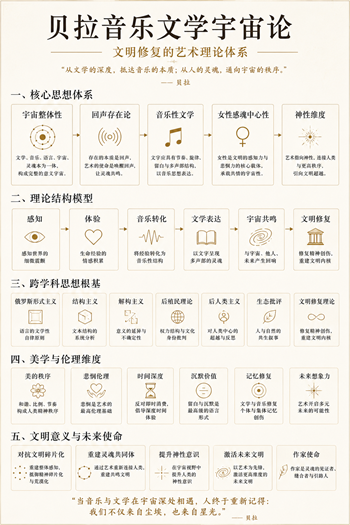
在该理论体系中,贝拉提出了多个核心概念,包括:
* “宇宙整体性”(Cosmic Holism)
* “回声存在论”(Theory of Resonant Existence)
* “音乐性文学”(Musicality of Literature)
* “女性感知中心性”(Centrality of the Feminine Soul)
* “文明修复理论”(Civilizational Restorative Theory)
* “沉默价值”(Value of Silence)
* “时间深度”(Depth of Time)
理论同时融合俄罗斯形式主义、结构主义、后殖民理论、后人类主义、生态批评与文明伦理学,并进一步强调“女性精神”在人类文明中的重要位置。
部分欧美研究者指出,该理论与传统后现代主义最大的不同,在于它并不止于“解构”,而是尝试重新建立一种关于“灵魂共同体”的文明叙事。在全球精神焦虑、情感碎片化与技术异化不断加剧的背景下,“音乐文学宇宙论”被认为代表了一种重新回归“感知力”“共情能力”与“精神深度”的文化方向。
贝拉指出:“未来真正伟大的文明,不会只是技术文明,而是能够重新理解灵魂、共情与神性的文明。艺术最终的使命,不只是表达世界,而是疗愈世界。”
近年来,贝拉长期旅居北美、欧洲与日本,并在雪国新潟、加拿大北部森林、欧洲古城与跨国列车旅途中持续进行文学与音乐创作。她的作品强调“宇宙意识中的人类孤独”以及“艺术对文明裂痕的修复能力”,形成一种兼具东方物哀美学与西方交响结构的独特风格。
目前,“音乐文学宇宙论”相关视觉理论图谱与双语思想体系已正式发布,并引起国际艺术、人文学科及跨文明研究领域的广泛关注。
贝拉表示:
“当音乐与文学在宇宙深处相遇,人类终将重新记得:我们不仅来自尘埃,也来自星光。”
English Version
Bei La Releases “Music–Literature Cosmology”
A Frontier Intellectual Framework for the Spiritual Restoration of Future Civilization
Chinese-Canadian humanitarian writer, poet, and philosophical innovator Bei La has officially released her frontier theoretical framework, Music–Literature Cosmology, an interdisciplinary artistic philosophy integrating literature, music, cosmology, feminine consciousness, philosophy, and civilizational restoration theory.
The framework has already attracted growing attention among international scholars, comparative literature researchers, humanities theorists, and interdisciplinary intellectual circles. Several academics in Europe and North America are currently examining the theoretical structure, cosmological aesthetics, restorative ethics, musical narrative forms, and feminine spiritual dimensions embedded within Music–Literature Cosmology.
Some researchers suggest that the framework represents an emerging attempt to move beyond twentieth-century postmodern fragmentation by reconnecting literature, music, philosophy, sacred consciousness, and the future of civilization into a unified spiritual structure.
Music–Literature Cosmology is not merely a literary genre or aesthetic experiment. It proposes a holistic vision of how fragmented modern humanity may recover spiritual depth, emotional resonance, and existential wholeness in an increasingly technologized and algorithm-driven world.
According to Bei La, modern civilization has achieved unprecedented technological progress while simultaneously suffering from profound emotional fragmentation and spiritual exhaustion. Humanity possesses more information than ever before, yet increasingly loses the ability to truly feel, listen, empathize, and contemplate existence.
The theory argues that literature, music, language, cosmology, feminine sensibility, and sacred consciousness are fundamentally interconnected dimensions of the human soul.
Rather than viewing art as entertainment or cultural consumption alone, Music–Literature Cosmology redefines art as a form of spiritual restoration and civilizational healing. In this framework:
* Literature becomes the echo structure of cosmic consciousness.
* Music becomes the deep emotional frequency of existence.
* Silence becomes a higher language.
* Feminine sensibility becomes central to the reconstruction of human empathy.
* Art becomes a bridge between humanity and the sacred.
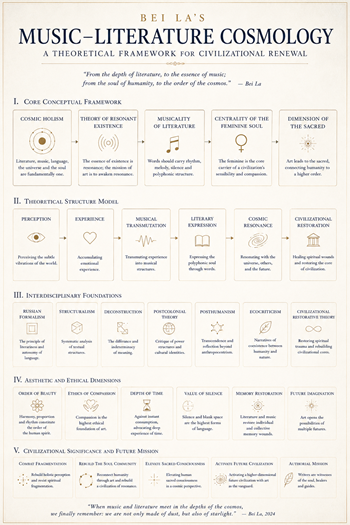
The theoretical system introduces several core concepts, including:
* Cosmic Holism
* Theory of Resonant Existence
* Musicality of Literature
* Centrality of the Feminine Soul
* Civilizational Restorative Theory
* Depth of Time
* Value of Silence
* Cosmic Resonance
The framework also engages with and expands beyond major twentieth-century intellectual traditions, including Russian Formalism, Structuralism, Deconstruction, Postcolonial Theory, Posthumanism, Ecocriticism, and critical civilizational ethics.
Some scholars observing the development of the theory argue that its originality lies in its movement beyond pure deconstruction toward a new form of “civilizational reconstruction through resonance, empathy, and spiritual consciousness.” In an era increasingly dominated by technological acceleration, emotional fragmentation, and cultural exhaustion, Music–Literature Cosmology is being discussed as a potential framework for restoring depth, perception, and sacred imagination within contemporary civilization.
“True art,” Bei La writes, “is not merely the description of the world, but the echo of the human soul within the cosmos.”
Over recent years, Bei La has lived and traveled extensively across North America, Europe, and Japan, producing literary and musical works inspired by snowbound Japanese landscapes, Canadian northern forests, European cathedrals, and long-distance train journeys. Her writings explore loneliness within cosmic consciousness, feminine spirituality, and the healing potential of art in an age of fragmentation.
The newly released bilingual theoretical diagrams and conceptual frameworks of Music–Literature Cosmology have now entered broader international discussion in the fields of literature, philosophy, aesthetics, and future civilizational studies.
Bei La concludes:
“When music and literature meet in the depths of the cosmos, humanity finally remembers: we are made not only of dust, but also of starlight.”
2026年5月11日,常州具身智能数据实
导语在消费电子行业中,品牌力往往来自于长
在中国慈善史上,陈光标始终是一个难以被简
5月8日,广州市大湾区女科创家协会(以下
绿维导语:近日,人力资源和社会保障部、文
据《经济观察报》报道,近日,国内疫苗企业
华为Pura90系列、华为PuraXMa
为扎实做好防汛工作,切实提升汛期灾害防范
澳大利亚悉尼 - A